
Until recently, my Artist Loud Masters were mastered to approximately −14 LUFS and −1 dBTP, following common streaming loudness recommendations.
After revisiting my mastering workflow and reconsidering how my music is actually used, I’ve decided to take a more music-first approach.
Going forward, my Loud Masters will no longer follow a fixed loudness target. Instead, each beat or track will be mastered individually, based on its character, dynamics, and the way I believe it sounds best. Whether that means −8, −9, −10 LUFS, or something entirely different, the music itself will determine the final result — not Spotify’s normalization target.
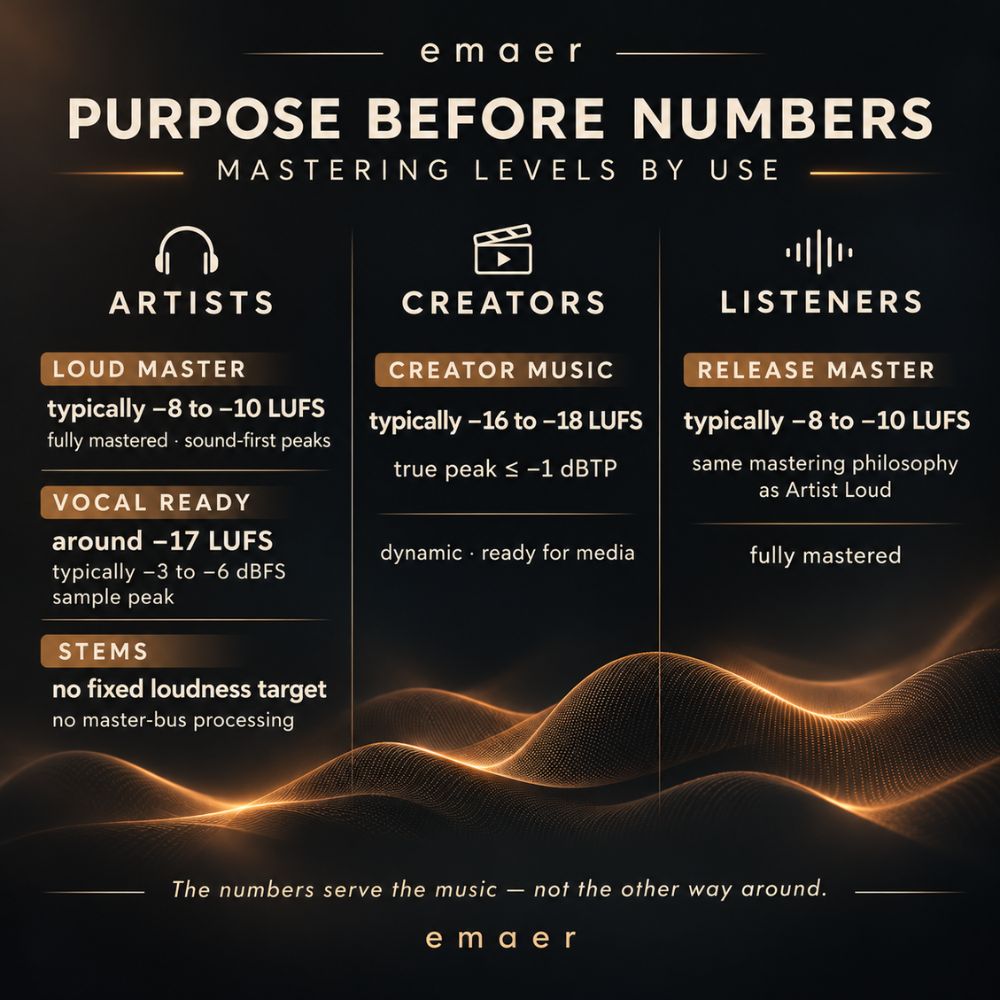
This also led me to refine my overall mastering concept, with clearer distinctions between music for artists, creators, and listeners. The updated standards described below will apply to new releases from now on.
Please note: Older beats and releases may still follow my previous mastering specifications. These versions remain available as originally produced and are not automatically updated to the new standards.
This change isn’t about the old approach being wrong. It’s about refining my process and giving each piece of music the mastering treatment that best serves its purpose.
Music for Artists
A beat made for an artist can serve two different purposes: it can be enjoyed as a finished instrumental, or it can become the foundation of a new song.
That is why my Artist Beat Producer Packs include different versions.
Loud Master
Typically −8 to −10 LUFS | Fully Mastered
This is the finished, release-ready version of the beat, with its full sound, punch, and intended loudness.
Rather than following a fixed loudness or peak ceiling, I master each beat according to its musical character. Some productions benefit from a louder, denser sound, while others need more space and dynamics.
The goal is always the same: to achieve the best possible balance of impact, clarity, and musicality.
This version is ideal for listening, writing, performing, and experiencing the beat as I intended it to sound.
Vocal Ready
Around −17 LUFS | Typically −3 to −6 dBFS Sample Peak
The Vocal Ready version is designed for artists who want to record and mix their vocals over a professionally prepared instrumental without having to mix the entire beat themselves.
It retains the tonal balance, compression, saturation, depth, and overall character of my mastering. However, the final loudness-maximizing stages are omitted to preserve the transients and leave sufficient headroom for vocals and further processing.
This means the beat already sounds polished and cohesive, while still allowing the vocals and instrumental to be brought together into a final song master.
The loudness and peak values are guidelines rather than strict limits. Preserving the sound and natural dynamics of the production always comes first.
Stems
Unmastered | No Fixed Loudness Target, typically around −26 LUFS
For maximum flexibility, the Producer Packs also include individual stems.
These retain the sound of the original mix but are delivered without master-bus processing. This gives artists and mixing engineers greater control over the balance, dynamics, and overall sound of the production.
Stems are especially useful when integrating the beat into a larger project, creating an album with a consistent sonic character, or developing a completely new mix around the vocals.
Music for Creators
Typically −16 to −18 LUFS | True Peak at or below −1 dBTP
Music used in videos, films, podcasts, and other media has a different purpose.
It often needs to work alongside dialogue, voice-over, sound effects, and other elements. Excessive loudness or limiting can make that integration unnecessarily difficult.
My Creator Music is therefore delivered as a finished, dynamic master with controlled peak levels and enough flexibility for further use in a larger production.
True Peak levels are monitored to reduce the risk of unwanted distortion during playback and audio encoding. The exact peak level does not need to reach a fixed ceiling.
The goal is music that sounds complete on its own while remaining easy to integrate into different media projects.
Music for Listeners
Typically −8 to −10 LUFS | Fully Mastered
When I release music purely for listening, the music itself is the finished product.
Just like the Loud Master versions of my artist beats, these releases are mastered according to their individual character rather than a rigid loudness standard.
A powerful Hip-Hop production might benefit from a dense, energetic master. A more spacious or cinematic piece might sound better with additional dynamics.
Loudness and peak levels are chosen to serve the music, with attention to sound quality across different playback formats.
Purpose Before Numbers
All these values are guidelines, not rules carved in stone.
LUFS describes perceived loudness, dBFS indicates digital sample peak levels, and dBTP helps assess peaks that may occur between digital samples during playback.
Each measurement serves a different purpose, and none of them tells the whole story about how music sounds.
In simple terms:
- Artists get a finished Loud Master, a polished Vocal Ready version, and flexible unmastered stems.
- Creators get dynamic, finished music that is easy to integrate into their productions.
- Listeners get the complete record, mastered for the best musical experience.
And when I am mixing or mastering music for a client, these targets do not automatically apply. In that case, I work according to the music, the client’s preferences, and the requirements of the intended release.
The numbers serve the music — not the other way around.