
Why My Music Comes at Different Loudness Levels
If you download music from me, you may notice that not every release is delivered at the same loudness.
That is intentional.
I create music for different purposes: for artists, for creators, and for listeners. And depending on what happens to the music after I deliver it, different levels of loudness and headroom make sense.
Rather than trying to make everything as loud as possible, I prepare each version for what it is actually meant to do.
Music for Artists
A beat made for an artist is not a finished song yet.
Vocals still need to be recorded, mixed and eventually mastered together with the instrumental. For that reason, I don’t see much value in pushing an artist beat to the same loudness as a finished commercial release.
My beats therefore usually come in different versions.
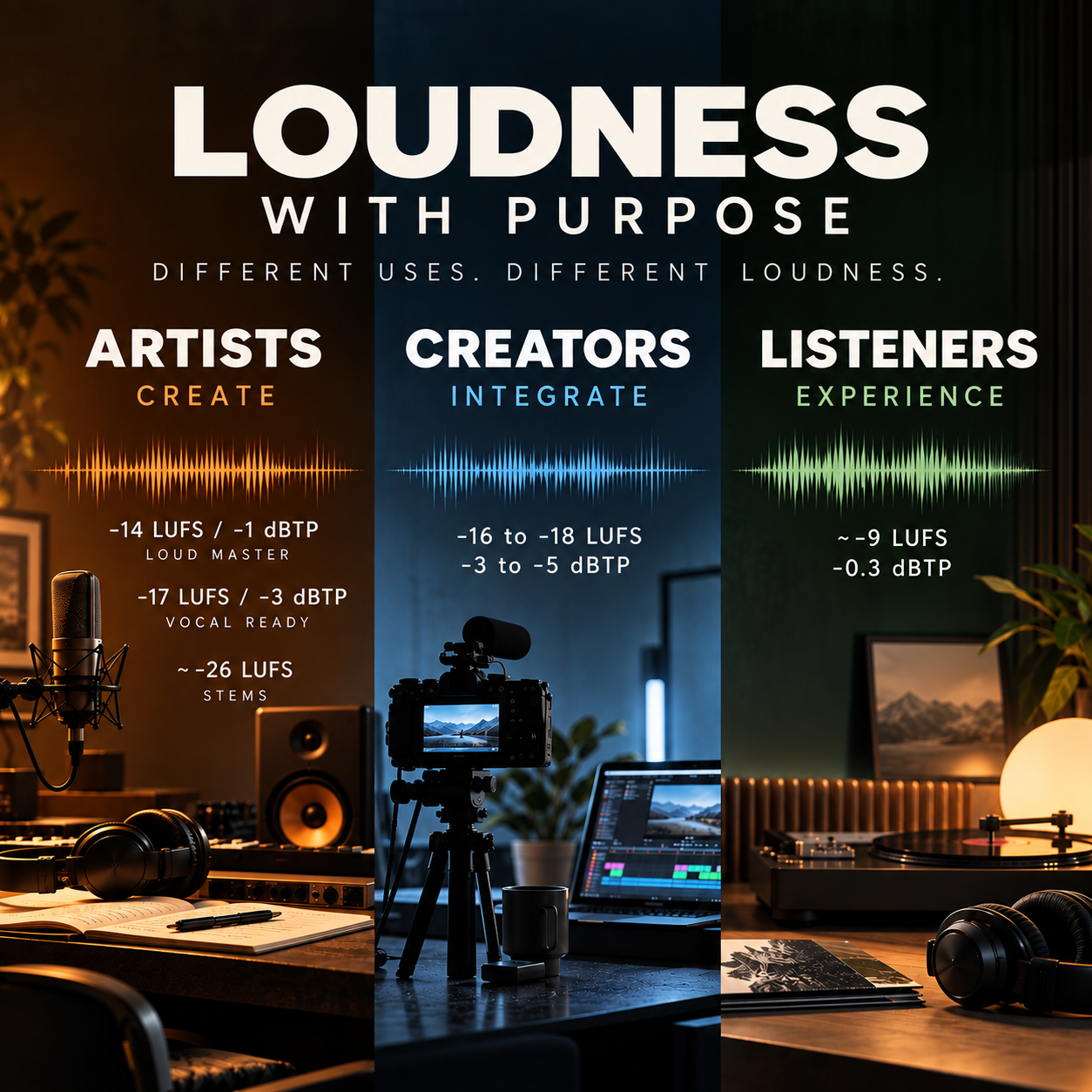
Loud Master
around −14 LUFS / max. −1 dBTP
This is the finished and polished presentation of the beat. It includes my mastering decisions and is loud enough to give you a good impression of how I intend the production to sound without unnecessarily pushing it into heavy limiting or clipping.
It is ideal for listening, writing and working with the beat.
Vocal Ready
around −17 LUFS / max. −3 dBTP
The Vocal Ready version leaves additional room for your vocals and further processing.
It still retains the sound and character of my master, but the final loudness processing is reduced. In many cases, this means less or no final limiting while the tonal and dynamic decisions that shape the beat remain intact.
The result is essentially the same production with more room to build a song around it.
Stems
typically around −26 LUFS
If you want maximum control, you also receive the individual stems.
These are not mastered like the stereo versions. They are intended for a proper mix with your vocals and give you or your mixing engineer access to the individual elements of the production.
At that point, my loudness targets are no longer particularly important — because the final song will get its own mix and master anyway.
Music for Creators
typically −16 to −18 LUFS / around −3 to −5 dBTP
Music used in videos, films, podcasts and other content has a very different job.
It often needs to sit underneath dialogue, voice-over, sound effects and other elements. A highly limited −9 LUFS master would often make that job unnecessarily difficult.
My Creator Music therefore has more dynamic and peak headroom built in.
It should sound finished on its own while still being easy to integrate into a larger production.
Music for Listeners
typically around −9 LUFS / max. −0.3 dBTP
This is different.
When I release an instrumental purely as music to listen to, the instrumental is the finished product. Nobody needs to add vocals, fit it underneath dialogue or build another mix around it.
So this is where I create my final release master.
I generally aim for around −9 LUFS with peaks up to approximately −0.3 dBTP, although the exact loudness always depends on the music. I would rather let a track breathe than force it towards a number that does not suit it.
Purpose Before Numbers
These values are targets, not rules carved in stone.
A quiet, dynamic piece may end up somewhere different from a dense Hip-Hop production. What matters to me is not hitting an exact LUFS value, but delivering music that works well for its intended purpose.
In simple terms:
Artists get room to create.
Creators get room to integrate.
Listeners get the finished record.
And when I am mixing or mastering music for a client, these targets do not automatically apply.
In that case, I work according to the music, the client’s preferences, the intended release format and the requirements of the platform or medium it is being prepared for.
The numbers serve the music — not the other way around.